
How to find clients for an AI automation agency (a prospecting method, not a marketing tip)
Every "how to get AI agency clients" post says post on LinkedIn and niche down. Useful, not actionable on a Tuesday. This is the actual method for finding the twenty companies still doing by hand the thing you automate.
 Aman Jha··7 min read
Search "how to find clients for an AI automation agency" and you get the same five answers. Niche down. Post on LinkedIn. Build in public. Offer a free audit. Ask for referrals.
None of that is wrong. It's also not what you can do on a Tuesday afternoon when the pipeline is empty. You need names. Specific companies, with a reason each one should take your call this month.
I built find-customer partly because I was that agency, so here is the method as I'd run it by hand, followed by the parts I automated.
To find clients for an AI automation agency: define the workflow you automate (not the technology), infer your ideal customer from the clients you've already served, look for public evidence that a company still runs that workflow manually (job descriptions are the best source), verify each one against a fixed set of checks, and reach out with the evidence in the first line.
Your AI agency ICP: sell the workflow, not the AI
The first thing to fix is the ICP, and the mistake is almost always the same: the profile describes a technology buyer instead of a workflow owner.
"Companies interested in AI automation" is not a customer. Nobody wakes up wanting AI. They wake up with 300 support tickets, or a dispatch spreadsheet, or an invoice queue that takes a person three days a week. Your ICP is whoever owns the manual version of the thing you automate.
So write your ideal customer profile as fields, from your case studies, not your ambitions:
| Field | Weak | Better |
|---|---|---|
| What you sell | AI automation services | Automated shipment status updates for logistics ops |
| Industry | Any | 3PL, freight brokerage, last-mile |
| Size | SMB to enterprise | 100 to 1,000 employees (big enough to have a dispatch team, small enough to not have built it) |
| Problem | Inefficiency | Customers updated by phone and email from a spreadsheet |
| Buyer | Decision makers | VP Operations, Head of Dispatch |
When the ICP inference stage reads an agency's site, it's told to weight case studies over the homepage for exactly this reason. Your homepage says "we transform businesses with AI." Your case studies say who paid and what for. Trust the second one. And if your case studies split into two genuinely different audiences, pick one per prospecting run. A blended profile matches nobody.
Where AI automation clients leave evidence that they still do it by hand
This is the part specific to agencies, and it's why generic lead-gen advice fails you. A SaaS company can look for people who already use a competitor. You're looking for the absence of a solution, and absences are harder to search for.
But they leave traces. In rough order of how much I trust them:
Job descriptions. The most honest text a company publishes. A posting for an "Operations Coordinator" that says "update customers on shipment status via phone and email, maintain our dispatch tracker in Excel" is a company telling you, in writing, that they run your workflow manually and are about to pay a salary to keep doing it. We pull these from public ATS boards (Greenhouse, Lever and Ashby all publish JSON with no auth) and quote the description as evidence. The full method is in how to read a careers page for hiring signals.
Headcount in the function. Careers volume in support, ops or back-office roles. Ten open support roles means a support org large enough to have the problem you fix. This is a proxy for problem evidence, and we weight it as such.
Stated initiatives. Annual letters, "our plans for 2026" posts, founder interviews. If a company wrote "we aim to automate shipment status communication this year" on its own news page, that's not a signal. That's a quote you put in the subject line.
Tooling gaps. Legacy or fragmented tools named on the site or in job posts. "Experience with our custom Access database a plus" is a real line I've seen and it's a flare.
Tool presence, with a twist. If they already use an automation platform or a competitor's product, is that good or bad for you? For a lot of agencies it means the itch is scratched. For others it's a displacement play. We made this an explicit ICP field (displace_competitors: yes/no) because the same evidence flips sign depending on the answer, and I didn't want a model guessing.
When the qualification prompt runs for an agency, it's specifically instructed to emphasise repetitive ops workflows, support and back-office headcount, ops hiring, legacy tooling, and stated AI initiatives. Those five are where agency-shaped problems show up in public.
The honest part: some ICPs are easy to find and some aren't
Here's what our scenario stress test showed, and it should change how you spend your time.
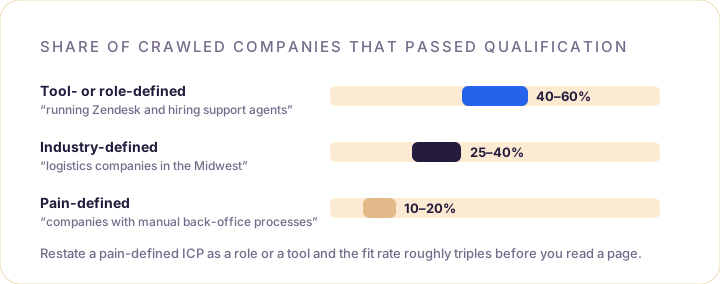
- Tool- or role-defined ICPs ("companies running Zendesk and hiring support agents"): 40 to 60 percent of the companies we crawled actually passed qualification. Signal sources do most of the work.
- Industry-defined ICPs ("logistics companies in the Midwest"): 25 to 40 percent. Depends on job aggregators, vendor customer pages and registries.
- Pain-defined ICPs ("companies with manual back-office processes"): 10 to 20 percent. Signal-first discovery adds little. You fall back to directories plus actually reading.
Most agencies start with a pain-defined ICP because that's how they think about their work. It's also the hardest one to prospect for. If you can restate your pain as a role ("companies hiring for the job we automate") or a tool ("companies whose job posts mention the spreadsheet we replace"), your fit rate roughly triples before you've read a single page.
Qualify the prospect before you write the email
You've got 60 to 100 candidates. Now the discipline that separates a list from a pile:
Every company gets the same checks. Industry, geography, size, company type, business model, problem evidence, hiring, and the disqualifiers: is it a competitor, is it even a company, is it already your client (yes, that has to be a check), is it dead. Each check is pass, fail or unknown, and a pass needs a quote and the URL it came from. If the About page doesn't state a headcount, size is unknown. You don't guess from the office photo.
Then the score, which is arithmetic on the verdicts rather than a model's opinion. The weights are in our ICP scoring formula. And a gate: at least two verified claims or the company doesn't make the list.
You'll end with maybe 15 to 25 companies. It'll feel thin compared to the 2,000-row scrape you could have bought. It isn't. It's the part of the 2,000 you'd have kept after a week of manual checking, with the checking already done.
The cold email writes itself if the research was real
The whole point of the evidence is one sentence:
Saw you're hiring three Operations Coordinators this quarter and the posting mentions tracking shipments from a dispatch spreadsheet. We built the automated version of exactly that for [client], took their update time from hours to minutes. Worth a look?
No "I hope this finds you well." No "AI-powered solutions." A specific role, a quoted line from their own job post, a matching case study. The reply rate difference between that and a template is not subtle, and the only way to write it at scale is to have the evidence on the card before you start typing.
Finding AI automation agency clients: what I automated and what I didn't
Steps two through four (finding the traces, reading four pages per company, running the checks, scoring) are what find-customer does when you paste your agency's URL. It's built for this exact shape of company: it reads your case studies to infer the ICP, stops so you can correct it, then researches and returns the short list with the quotes attached. The free run covers eight companies, which is enough to see if the evidence on the cards is real.
Step one, deciding what you actually sell, stays yours. Every time. The tool will infer a profile from your site, and it'll be a decent guess, but you're the one who knows the difference between the client you had and the client you want.
Get that right and the rest is mechanical. Which is exactly what mechanical things are for.